“Any artist lives where he is popular”
Sometimes Alexander Kosolapov is called the most non-Russian among Russian artists. One of the works by Alexander Kosolapov will be on view at the exhibition “Russia” in Guggenheim museum. It will be the first retrospect of Russian art in America, though Alexander doesn’t live in Russia, but in America.
— You were one of the first artists who left the former USSR. Thirty years ago you left Moscow in which you were a very well-educated professional artist.
I got a unique education. After being thirty years in the West I understood that we had got absolutely unique education in Russia. Why was it so unique? We were given a very serious academic school, which was phenomenally expensive. Once Pratt Institute Chancellor told me “Who can afford to study a nude model today?” But we did it. We studied at the Institutes for five or six years. And before that I had finished school of art. I’ve drawn professionally since 10 years old. Sometimes I say that I drew like Angers when I was 15. People laugh, but if you look at those paintings, you’ll see that they were absolutely French.
— Tough you have marvelous academic skills, you didn’t want to draw birches and flowers…
When I want, I draw both birches and meadows but in another contest and meaning as it is accepted in the school of the XXI century. Besides, XXI and XX centuries are absolutely different in approach to art. The XX century is a century of modernism and postmodernism. And as I started my education in the middle of this century, then I heard of modernism, and I met the XXI century as a postmodern artist.
— How did you come to know the backwash of modernism which was so unwelcome in the USSR?
I studied in Moscow art school of the Surikov Institute which was situated in front of the Tretyakov Gallery. We were on friendly terms with nice people who worked in its vaults. They invited us there. It was there where I first saw Chagall, Kandinsky, Malevich. The museum employees took pictures out of boxes, blew off dust and put them in front of us. I could see and compare. You know, we were taught socialist realism. But in that library we were given some other parameters: as there is not only one model of imaging. There are lots of them. There was also a library of foreign literature where we could find out much from magazines and books.
— When did you start doing what you are doing now? What pushed you?
Pop art “baptized” me. After I finished all possible art Institutions of my former motherland I was thrown to real life and at once understood that official career was not for me.
— Was it so boring for you?
I hated any ideological control. This position led me to what I am doing now. Pop art is somewhere between modern and postmodern. Like other pop artists I experimented with hangers, locks and other welfare items. Then I started to shift smoothly to the social theme. It happened when we prepared for the exhibition with Komar and Melamid with whom I studied at the Stroganov Academy. I studied at the Faculty of Monumental Sculpture and they studied at the Faculty of Design. The exhibition didn’t open. But my first works are rather popular, they are in many catalogues. They are as follows: “Study, son”, “Aurora”. They combine traditions of pop art and socialist realism.
I’d like to remind you that postmodern means use of quotation and some stylistic devices and concrete images of the past but in a new context. In this respect I came up against strange situations. When I pictured “Coca-Cola. It’s a real thing” with Lenin’s portrait, who was the author of the quotation, Coca-Cola’s lawyers took legal proceedings against me. They said that my picture made “Coca-Cola” Company look like a sponsor of communism.
It was a time of “cold war” and any artist appearing in the West after the East, leaped fall out of the frying pan into the fire, out of one ideology into another and again became a whipping boy. Thus my design of “Coca-Cola” became a symbol of the “cold war”. Another design “McLenin” in some measure became a symbol of perestroika, it was reproduced for millions of times, it was sold in Arbat Street and everywhere in the former Soviet Union during perestroika. I think that I am a happy artist as my works are interactive; they are not passive towards the spectator, social environment and political situation. They always make spectators to react.
— Each artist wants to be seen, wants to get response from spectators. But many people don’t understand the real context of your pictures. Because of that conflicts develop not only in America but in Moscow as well. It is proved by the featured story with the exhibition “Caution: religion!”
Everything started with the lection of Slavoj Zizek. He is one of the most famous modern philosophers. He lives in Ljubljana. I met him there and he invited me to his exhibition in New York. His lectures are very popular and are held with a large abundance of people and sometimes it’s even necessary to call police. He is the first philosopher whose lectures drew more spectators than there can be in the auditorium. Zizek spoke about religion. Today it’s clear that Islam, Christianity and Judaism are the most painful points of our history. And it’s clear that confrontation between capitalism and communism is in past now and we live in the situation of confrontation of religions. Zizek said that God and people are not clear to each other today and the contract between God and people is broken. Everything is different, people remain alone and God is alone.
It pushed me to put in Times Square advertisements of “Coca Cola” with Jesus Christ who says: “This is my blood”. We know that Jesus Christ and the Virgin Mary manifested themselves to country people in Spain, in the Balkans. And my God comes to the most crowded place in America, to the world crossroad and manifests himself in advertisements. God of course couldn’t manifest himself in Times Square, but we live during postmodern and God must comply with it.
Moscow magazine “Itogi” (“Results”) which devoted me an article bought a silkscreen copy of the sculpture and then gave it to the exhibition “Caution: Religion!” which was held in the Andrei Sakharov Center unknown to me. Hooligans from militant orthodox groups came to the exhibition and destroyed it. The Sakharov Center filed a case. But a counter-case was filed against the organizers of the exhibition. There was a very serious process which could lead both the exhibition curator and the director of the center Mr. Samodurov to many years imprisonment for sponsoring the exhibition which insulted religious feelings of believers. I didn’t want to be mixed up in this story. I don’t want to take part in inter-religious scandals. And in all interviews I tried to explain that my position is a position of a postmodernist and it can’t insult anyone.
— Let’s return to the seventies. How did you grow into the American culture?
My philosophy has always pushed me to the western culture. That doesn’t mean that I don’t love Russian culture. Of course I love it. An emigrant is a political position, it is of little importance for me and I have never considered myself to be a dissident. But to be an artist in the XX century is a very important process, we had to obtain skills of the new culture. That’s why I didn’t go to Israel or Germany and didn’t stay in France as many of my colleagues did. I went to New York, to this Mecca of modern art to work and develop in this situation which is very difficult, but at the same time very creative and exciting. And I think that I am a real artist. I managed to absorb everything that happened during these years in American fine art. But nevertheless I never refused that I am a Russian artist.
— Full assimilation is probably impossible for an artist…
It’s possible to become an American citizen, but the attempt to change one’s personality and to become an American won’t be successful. An artist doesn’t have a right to refuse his legacy. There are also cosmopolitan forms of art and forms connected with the national “field”. My experience gives me a right to confirm that artists have nationality. Andy Warhol is an American citizen, Eve Cline is a French citizen, though both of them are international. If we speak about Alexander Kosolapov as of an artist, I’d say that he is a modern artist but Russian one. I tried to speak the language of postmodern about Russian problems, the situation in Russia, about Russian culture in the context of internationality. Thus I am an artist drawing Russian culture in the international context.
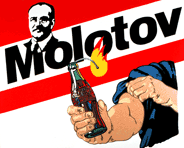
— Perhaps, your work “Molotov cocktail” may comment on it?
I made it at the end of the eighties, at the beginning of forming a normal market in Russia. “Molotov cocktail” is an imagery advertisement of an imagery product, though during the war “Molotov Cocktail” was used for destroying fascists’ tanks. I thought that it would be a good thing to invent such a drink and put it up for sale in Russia. I didn’t go so far, but I designed the advertisement.
— And what about another “synthesis” in which you “rewarded” the famous “Worker and farmgirl” with the heads of Mickey Mouse and his girlfriend Mini…
In 1937 this sculpture was exhibited at the World Exhibition in Paris in front of the German show room. At that time confrontation between the Soviet and German showrooms symbolized confrontation between Russia and the fascism. Each country wanted to have a higher showroom. Thus they were becoming higher and higher. And at last Russian showroom wined thanks to the “Worker and farmgirl”.
— There will be a sort of “returning” soon. Your Mickey and Mini are going to a big exhibition in Paris.
The first non-US retrospect-research of Walt Disney creative work is going to be held in Palais Royal. His European roots in particular will be studied there. It develops that Disney summoned a huge group of the great European artists, made a phenomenal research of European culture, fabulous culture in particular. He studied works by the brothers Grimm, folklore, symbolism, culture of the XIX century. There will be a section named “Walt Disney and his influence on modern art”. America will be represented by the works of Warhol and Lichtenstein. As for the Eastern block countries, perhaps I’ll be the only representative. My sculpture was chosen by the jury. By the way, after that the exhibition will go to Montreal.
And there was a funny story about this sculpture. It was exhibited in the “Art-Moscow” Exhibition the year before yesterday and was bought by one of Moscow banks. When I secured an order to make one more copy of this sculpture, I went to the caster. However he said that he won’t make this dirt.
— Soviet people were always very emotional in regard to art. They estimate and act in accordance with the estimation.
That’s right. They have their own opinion and their own criteria. “It’s impossible to buy people’s love” the artist Glazunov used to say.
— You are already an accomplished artist in America and now you are spending more and more time in Moscow. How do you interact with new Russian reality and do you think that it differs much from the previous one?
I’ve started visiting Russia since the beginning of the nineties. At that time I didn’t see way to take part in Moscow artistic life as the situation with fine art in Russia was very strange, chaotic. As I had lived in America for thirty years, I know how difficult it is to realize oneself in the market structure. However, in the modern culture market is a sort of criterion for recognition or non-recognition of an artist. And I set myself a task to take an active part in art market when it occurred in Russia. Now there are galleries, modern art exhibitions including International ones in Russia and my participation is necessary there. You can spend much time in a foreign country, but you’ll be treated like Russian yet. You’ll attract interest as something exotic. Though I must say that Russian public also treats me like some exotic “American Russian”.
— As far as I know, your works are popular in Russia now and very rich people buy them. How does it happen?
I know gallery owners, curators; my works are often exhibited. By the way, this social situation is very interesting. Let’s say, you are in a party where you meet Russian millionaires. Being a member of the market society I must behave according the situation. In New York for instance nobody cares about the way you are dressed. But in Russia everyone are just out of bandbox, as everyone needs to present themselves. Everyone treat you like a foreign guest and listen to what you are saying. And suddenly somebody introduces me in the following way: “This is our classic” or “This is a great Russian artist, you must buy his work”. Not so long ago I met a very rich Russian man, the owner of the phenomenal collection. I showed him sketches of my works and he answered at once: “I buy it”. I was taken aback, and he said: “Go to the kitchen and have mushroom soup”. There was a nice woman from the city of Pskov in the kitchen. We started talking about Pskov, about nature, lakes, a country house. And suddenly I was brought a packet of money. Such funny situations always occur in Russia.
— Are you going to live on two continents?
Any artist lives where he is popular. Today I have a lot of projects both in Russia and in America. Thus I’ll live between New York and Moscow.
Interview by Maya Pritsker
Available at NRS.com
Александра Косолапова иногда называют самым нерусским из русских художников. В Музее Гуггенхайма, на выставке «Russia!», которая явит собой первую в Америке ретроспективу искусства России от икон до сегодняшнего дня, Александр Косолапов будет представлен одной из своих работ. Хотя живет он не в России, а в Америке.
— Вы были одним из первых художников, кто уехал из бывшего СССР. Тридцать лет тому назад вы покинули Москву, в которой были профессиональным художником с очень хорошим образованием…
— С уникальным. Прожив тридцать лет на Западе, я понял, что в России мы получали абсолютно уникальное образование. В чем его уникальность? Нам давали очень серьезную академическую школу, которая феноменально дорога. Как-то, разговаривая с ректором Пратт-института, я услышал от него: «Кто же сегодня может позволить себе пять лет изучать обнаженную натуру?». А мы это делали. Учились в институте по пять-шесть лет, а до института я закончил художественную школу. Я профессионально рисую с десяти лет. Я иногда говорю, что в 15 лет рисовал как Энгр. Люди смеются, но если посмотреть на те рисунки, то это абсолютно французская школа.
— Обладая столь замечательным академическим мастерством, вы, тем не менее, не стали рисовать березки и цветочки…
— Когда мне надо, я рисую и березки, и луга, но совершенно в другом контексте и значении, нежели это принято в школе XIX века. Вообще, XIX и XX века очень разнятся в подходе к искусству. XX век — это век модернизма и постмодернизма. Поскольку я начал свое образование в середине этого века, то до меня дошли отголоски модернизма, а XXI век я встретил как художник-постмодернист.
— Каким образом отголоски нежеланного в СССР модернизма стали вам известны?
— Московская художественная школа при Институте Сурикова, где я учился, находилась напротив Третьяковской галереи. У нас были очень хорошие отношения с милыми людьми, которые работали в запасниках Третьяковки. Они приглашали нас в свои пыльные подвалы. Там я впервые увидел Шагала, Кандинского, Малевича. Картины вынимали из ящика, сдували пыль и ставили перед нами. Я мог увидеть и сравнить, что было и что есть. Ведь нас учили социалистическому реализму. А тут нам были даны некоторые параметры: не одна только модель видения существует — их множество. Была еще Библиотека иностранной литературы, где многое узнавалось из журналов и книг.
— Когда вы начали делать то, что делаете сейчас? Что вас к этому подтолкнуло?
— Мое «крещение» произошло через поп-арт. Закончив все возможные художественные заведения, какие только были в нашей прошлой родине, я был выброшен в простую жизнь и сразу понял, что не буду посвящать себя официальной карьере.
— Потому что это было скучно?
— Потому что я не терпел никакого идеологического контроля над собой. Я считал, что художник — это человек уникального и свободного занятия. Эта позиция привела меня к тому, что я делаю. Поп-арт находится на стыке того, что мы называем модерном и постмодерном. Подобно поп-артистам, я экспериментировал с вешалками, замками и другими бытовыми предметами. Потом стал плавно переходить к социальной теме. Это произошло при подготовке к выставке с Комаром и Меламидом — мы вместе учились в Строгановке, я — на отделении монументальной скульптуры, они — на отделении дизайна. Выставка не состоялась. Но первые мои работы довольно известны, они входят во многие каталоги. Это «Учись, сынок», «Аврора». В них соединились традиции поп-арта и соцреализма.
Я напомню, что постмодерн — это использование цитаты, использование определенных стилистических приемов или конкретных образов прошлого, но в новом контексте. В связи с этим у меня возникали странные ситуации. Когда появилась картина «Coca-Cola. It’s a real thing» — с портретом Ленина, которому принадлежит цитата, адвокаты компании «Кока-Кола» начали процесс против меня. Они заявили, что моя картина представляет компанию «Кока-Кола» как спонсора коммунизма.
То было время «холодной войны», и художник, попав с Востока на Запад, попадал из огня в полымя, из одной идеологии в другую и опять становился «объектом для битья». Так что мой дизайн с «Кока-Колой» стал символом «холодной войны». Другой мой дизайн — «Макленин» — в какой-то мере стал символом перестройки, репродуцировался миллионы раз, продавался на Арбате, на всех перекрестках бывшей Совдепии в перестроечный период. В известном смысле я счастливый художник, поскольку мои работы интерактивны, они не пассивны по отношению к зрителю, к социальной среде и к политической ситуации. Они постоянно вызывают ответ, реакцию зрителя.
— Каждый художник хочет быть увиденным, получить отклик. Но многие «читают» в ваших картинах совсем не то, что вы подразумеваете. Из-за этого возникают конфликты не только в Америке, но и в Москве, о чем говорит нашумевшая история с выставкой «Осторожно, религия!»…
— Началось все с лекции Славоя Жижека. Это один из самых известных современных философов. Он живет в Любляне. Там мы с ним познакомились, и он меня пригласил на свою лекцию в Нью-Йорке. Его лекции проходят при большом стечении народа, иногда даже вызывается полиция. Он первый философ, на которого хотят попасть больше слушателей, чем вмещает аудитория. Жижек говорил о религии. Сегодня ясно, что ислам, христианство и иудаизм — самые болевые точки нашей истории, что конфронтация капитализма и коммунизма отошла в прошлое и мы существуем в ситуации противостояния вер. Жижек говорил о том, что Бог и человек сегодня не ясны друг другу, договор между Богом и человеком нарушен. Все смешалось, люди остались одинокими, и Бог одинок.
Это меня натолкнуло на новую идею: поместить на Таймс-сквер рекламу «Кока-Колы» с изображением Иисуса Христа, который говорит: «Это моя кровь» — «This is my blood». Мы знаем, что Христос и Дева Мария являлись сельским людям в Испании, на Балканах. А у меня Бог приходит на самое многолюдное место Америки, на «перекресток мира» и являет себя на рекламе. Конечно, прежний Бог не явился бы на Таймс-сквер, но мы живем во времена пост-модерна, и Бог должен им соответствовать.
Московский журнал «Итоги», который посвятил мне статью, купил шелкографию с этим дизайном, а через некоторое время дал ее, без моего ведома, на выставку в Сахаровском центре — «Осторожно, религия!». На выставку пришли хулиганы из воинствующих православных группировок и разрушили ее. Сахаровский центр подал иск. Но на устроителей выставки был подан встречный иск. Был очень серьезный процесс, который грозил и куратору выставки, и директору центра Самодурову годами тюрьмы за спонсирование выставки, оскорбившей религиозные чувства верующих. Я попал в эту историю невольно. Я не хочу участвовать в межрелигиозных скандалах, и во всех интервью, которые я давал, я пытался разъяснить, что моя позиция — это позиция постмодерниста и она не может никого оскорбить.
— Вернемся в 1970-е годы. Как проходило ваше «врастание» в американскую культуру?
— По своей философии я всегда тяготел к западной культуре. Это не значит, что я не люблю русскую культуру, — несомненно, люблю. Эмигрант — политическая позиция, она меня мало волнует, и к диссидентам я себя никогда не причислял. Но быть художником в ХХ веке — очень важный процесс, он требовал приобретения навыков новой культуры. Вот почему я не поехал в Израиль или в Германию, не остался во Франции, как многие мои коллеги. Я приехал в Нью-Йорк — в эту Мекку современного искусства, чтобы работать и развиваться именно в этой, очень сложной, но очень возбуждающей и творческой, ситуации. Я считаю, что как художник я состоялся. Мне удалось вобрать главное из того, что происходило в эти годы в американском изобразительном искусстве, но я и не отказался от того, что являюсь русским художником.
— Полная ассимиляция для художника, наверное, невозможна…
— Можно стать американским гражданином, но попытка переменить свою личность и стать американцем ни к чему не приведет. Художник не имеет права отказываться от своего наследия. Существуют и космополитические формы искусства, и формы, связанные с национальным «полем». Мой опыт все больше дает мне право утверждать, что художники все же имеют национальность: Энди Уорхол — американский художник, Ив Кляйн — французский, хотя оба они интернациональны. Если говорить об Александре Косолапове как о некоем художественном факте, то я бы сказал, что это современный художник, но русский художник. Я старался говорить языком постмодерна о русских проблемах, о русской ситуации, о русской культуре, внедренной в интернациональный контекст. Я художник, создающий русскую культуру в интернациональном контексте.
— Это, наверное, можно прокомментировать вашей работой «Молотов коктейль»…
— Я создал ее в конце 1980-х, когда в России начал формироваться нормальный рынок. «Молотов коктейль» — это некая воображаемая реклама некоего воображаемого продукта, хотя «Коктейль Молотова» использовался во время войны для уничтожения фашистских танков. Мне показалось, что неплохо было бы изобрести такой напиток и представить его на продажу на русском рынке. Дальше этого я не пошел, но дизайн рекламы создал.
— А вот другой «синтез», в котором вы «наградили» знаменитых мухинских «Рабочего и колхозницу» головами Мики-Мауса и его подружки Мини…
— В 1937 году эта скульптура стояла на Всемирной парижской выставке напротив немецкого павильона. Противостояние советского и немецкого павильонов символизировало в то время конфронтацию России с фашизмом. Каждая страна хотела сделать свой павильон выше. Два павильона росли и росли, пока наконец русский павильон не стал выше благодаря «Рабочему и колхознице».
— А теперь состоится своего рода «возвращение» — ваши Микки и Минни едут набольшую выставку в Париж…
— Там, в Пале-Рояле, готовится первая внеамериканская ретроспектива-исследование творчества Уолта Диснея. Она, в частности, рассматривает его европейские корни. Оказывается, Дисней собрал огромную бригаду выдающихся европейских художников, провел феноменальное исследование европейской культуры, в основном сказочной. Он исследовал братьев Гримм, фольклор, символизм, культуру XIX века. Там будет также отдел «Уолт Дисней и его влияние на современное искусство». Америка будет представлена работами Уорхола, Лихтенштейна. А из стран восточного блока я, возможно, буду там единственным. Мою скульптуру выбрало жюри. Выставка, кстати, поедет потом в Монреаль.
А со скульптурой связана довольно смешная история. Она была выставлена позапрошлой весной на выставке «Арт Москва» и куплена одним из московских банков. Когда я получил заказ на еще один образец этой скульптуры, то отправился к литейщику, но тот сказал: «Эту гадость я делать не буду».
— Советский человек всегда очень эмоционально относился к искусству. Он выносит оценку и в соответствии с ней совершает действие…
— Совершенно верно. У него есть собственное мнение и собственный критерий. «Любовь народа не купишь» — как говорит художник Глазунов.
—Утвердив себя в Америке как художник, вы сейчас проводите все больше и больше времени в Москве. Как вы взаимодействуете с новой российской действительностью, и насколько она для вас отличается от старой?
— Я стал ездить в Россию с начала 1990-х годов. В тот момент я еще не видел возможности для себя участвовать в московской художественной жизни: ситуация с живописью в России была странной, хаотичной. Поскольку я прожил тридцать лет в Америке, я хорошо знаю, как сложно художнику реализовать себя через рыночную структуру. Между тем в сегодняшней культуре рынок является мерой художника, критерием его признания или непризнания. И я поставил для себя задачу: когда в России возникнет художественный рынок, активно в этом участвовать. Теперь в России появились галереи, выставки современного искусства, в том числе международные, и мое пребывание там стало необходимо. Можно провести очень много времени в чужой стране, но все равно к вам будут относиться как к «русскому». К вам будет интерес как к чему-то экзотическому. Хотя, надо сказать, что для русской публики я тоже пока нечто экзотическое: «американский русский».
— Насколько я знаю, ваши работы пользуются успехов в России, причем покупают их люди очень состоятельные. Как это происходит?
— У меня есть свои галерейщики, кураторы, мои работы представлены на выставках. Но вообще это очень интересная социальная ситуация. Скажем, вы попадаете на «парти», где присутствуют русские миллионеры. Как «рыночное существо», я должен себя вести определенным образом. В Нью-Йорке, например, никто особенно не думает, как одет. А в России все одеваются с иголочки, там нужно себя презентовать, там за тобой следят как за заморской птицей, слушают, что говоришь. И тут кто-то меня представляет: «Это наш классик» или «Это великий русский художник, вы должны его купить». Недавно я познакомился с очень богатым россиянином, обладателем феноменальной коллекции. Я показал ему эскизы своих работ, и он мне сразу сказал: «Покупаю». Я опешил, а он говорит: «Иди на кухню, тебя там угостят грибным супчиком». На кухне сидит замечательная женщина, родом из Пскова. Начинаем разговаривать: про Псков, про природу, озера, как бы там дачу купить. И тут мне приносят пакет. С деньгами. В России все время возникают вот такие забавные ситуации.
— Вы собираетесь жить на два континента?
— Художник живет там, где он востребован. Сегодня я делаю много проектов и в России, и в Америке, так что жить буду между Нью-Йорком и Москвой.
Беседовала Майя ПРИЦКЕР
Материал NRS.com