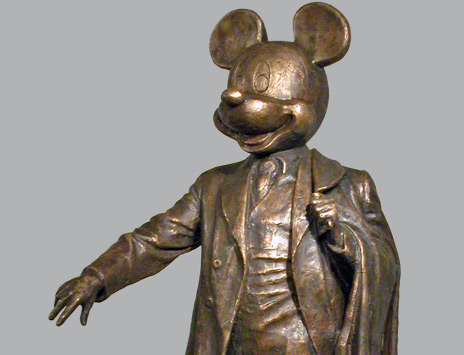
Mickey-Lenin
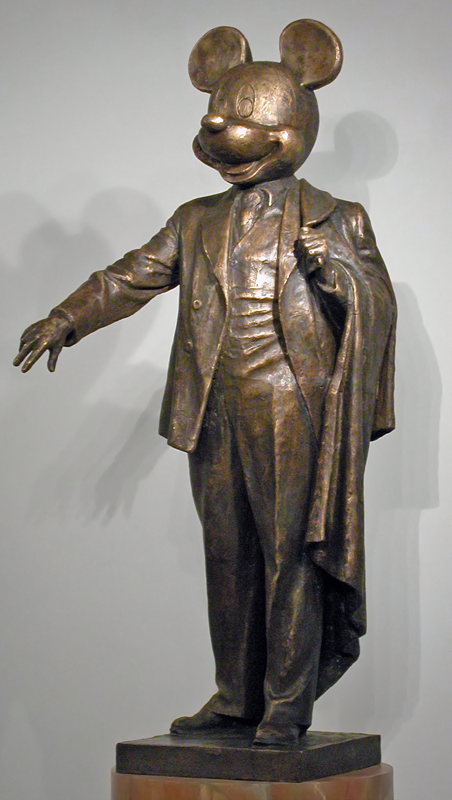
MICKEY LENIN
2003, Bronze, 51.2x63x23.6″
God Bless Mickey-Lenin
Recently, when I was trying to persuade a Russian curator to include Mickey-Lenin in yet another exhibition, I was met with a lack of understanding of the main elements of this work, which has been already shown numerous times.
In principle, I am against commenting on my own work verbally, but I discovered the need for it to be done due to differences in perception that arise from my experience (life in Russia during the Soviet period, a reasonably long period of time spent in America) and perspectives based on a different set of life experiences typical for the Russian public, as well as some of the curators and critics.
As I understand it, most of this curator’s questions came down to the appropriateness of combining the body of Lenin with the head of Mickey-Mouse. Equally in question was the material of which the object was made – bronze. I offered him my explanations, which went like this:
In the West, having become immersed into a different life, I had to develop a different language and different artistic methods.
Here is how the critic Margarita Tupitsyn described this strategy relative specifically to the sculpture Mickey-Lenin:
“The artist uses the following characteristic of human perception – the omission or even distortion of one of the elements of imagery stereotype, which does not suppress the capability of its automatic recognition. This allows Kosolapov to develop an original type of doubling object, simultaneously referring to two externally similar, but baring no relation to one another whatsoever, stereotypes of American and Russian mass-culture.
For Kosolapov the role of the imported element (of social origin) is in the destruction of that setting in which he is placed (the setting, consisting of adopted cultural stereotypes). Lenin and Mickey Mouse become mutually interchangeable, as products of mass culture. Creating this radical collage, the artist implies that in spite of the conflicting relations between the two systems, the distinguishing characteristics of which are the symbols used by him, their main aims – to convince the population of the authenticity and sincerity of their products – without a doubt match one another.”
In thinking back to the past, I am reminded, that the idea for this sculpture came to me when I first arrived in America. I had stumbled onto a trash heap by accident and found the plastic head of a toy Mickey Mouse. I took it home, turned it this way and that in my hands… On my desk, there stood a small sculpture of Lenin – and so I put the plastic Mickey head on it. They fit perfectly.
The other nostalgic side of the Lenin – Mickey Mouse project returns me to my childhood experiences of going every day to my lessons at the MSKhSh (Moscow Art Middle School) and needing to switch trains at the Revolution Square metro station.
Bronze figures – soldiers, athletes – and other representatives of various social groups placed in marble niches were firmly tied in my mind to the Soviet style and were reborn despite my conscious will in the ideal, fantastic space of my future sculptures. After all, both bronze and marble can also be borrowed as citations or as ways of transmitting oneself in terms of the Lacanian Other.In short, Lenin, Mickey, and the worker and the kolkhoz woman (Mickey-Minnie) were conceived and created for that kind of idealized space and could easily exist in it even today. This was my tribute to the Stalin style, of which I am in awe.
Nostalgic Sots-Art
Truth be told, for me as someone who has lived in Moscow for a long time, that city without Stalinist architecture is deprived of a large part of its aura. As for being an artist, in the end, it is a person who simply shares his vision with others. Thus, as a Russian artist living in New York, I dreamt of accomplishing just that where my own vision was concerned and was happy that I succeeded.
Now a few words about the style of Mickey-Lenin.
This work is based on the method of bringing together two opposing semiotic fields (symbols, signs, icons).
One field is the socialist realist Lenin (the prototype for which was the statue of Lenin by the famous Soviet sculptor Nikolai Tomsky), which I take as an integrated semiotic block created in the socio-cultural space with its own philosophy and system of creating an effect (Socialist Realism).
One of the big advantages I saw in this figure was that this large block of mass culture was already implanted in the people’s conscience, and the work was done for me before I came along inside the millions of tons of grey brain matter that is called the “social consciousness.”
Along with the other component of this work – Mickey – the two work not only the binary oppositions of East-West, Russia-America, Communism-Capitalism, the sublime – the trashy, the beautiful – the ugly, or good – evil, but also as the high and low in art. Hence Lenin stands for classical high art; his pose of a Caesar interprets the famous Roman sculpture and appeals to the masses in its capacity as something significant in the vertical social hierarchy, a representative of what the propaganda machine calls “aesthetically beautiful and eternal values.” And Mickey, then, is the horizontal element – low, consumerist, trashy – a travesty of a freakish mask.
My personal interest in Mickey is connected not only to Sergei Eisenstein, who called him the greatest actor of his epoch, but also to Hitler who, like all dictators following him, was a fan of Mickey (a hero who is a distorted antihero).
Long story short, Mickey Mouse, as the “pulp fiction, trash culture hero” who has very much entered the cultural vocabulary, is worthy of being brought together with the “great proletarian leader of all progressive humanity.”
Yet another interesting trajectory that repeats itself along the lines of the familiar “good-bad” opposition schema is the real-life history of the sculpture Mickey-Lenin.
2003. Berlin—Moskau,
The sculpture is shown at the Martin Gropius Bau and receives much attention from the German press. The exhibition is a success.
2004. Moskau—Berlin,
The parallel half of the project is an exhibition at the Historical Museum on Red Square; at this show, the new “main line of the new Russian art” tries out its strength. I ask the question, “Where is my sculpture?” The curator answers, “We didn’t have the space for it.” The exhibition is a success.
2005. NewYork, Guggenheim,
The show Russia!; Mickey-Lenin is not shown. “This is no place for freaks.” The exhibition is a success.
2005. New York, White Box Gallery,
Russia 2, a project of the Guelman Gallery; ”Mickey-Lenin” has its due place. The exhibition is a success.
2007. The Second Moscow Biennial of Contemporary Art
Tretyakov Gallery; the show Sots-Art. Mickey-Lenin is not represented. “This is no place for freaks.” The exhibition is a success.
2007. The Second Moscow Biennial of Contemporary Art
Sacharov Center, the show Forbidden Art; Mickey-Lenin has its due place. The exhibition is a success. There is criminal proceedings started against the director of the Center and the curator of the show.
“God bless Mickey-Lenin!”
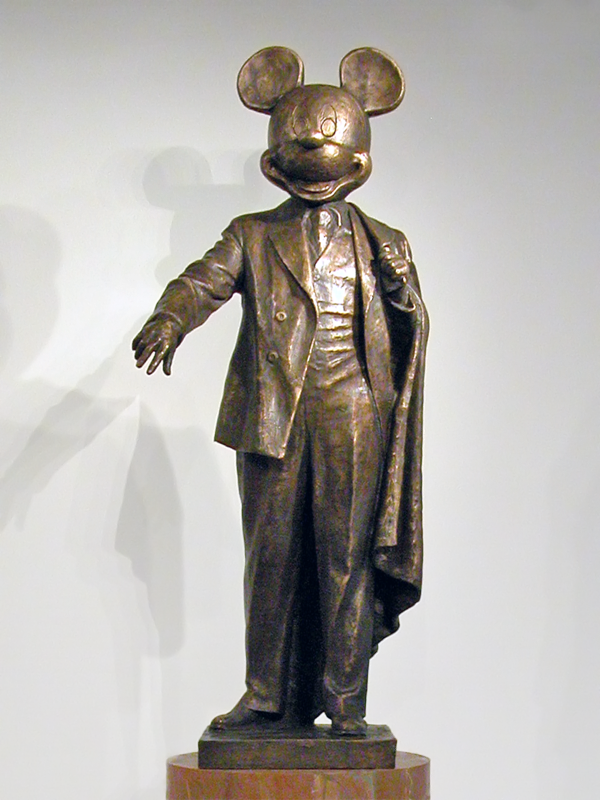
God Bless Mickey-Lenin
Недавно, уговаривая одного из русских кураторов включить «Микки-Ленина» в очередную выставку, я столкнулся с непониманием главных элементов этой работы, которая выставлялась уже множество раз. В принципе я против вербального комментирования своих работ, но столкнулся с необходимостью это сделать из-за разницы в восприятии, которая возникает из моего опыта (жизнь в России, в советское время, достаточно долгая жизнь в Америке) и другого видения, основанного на другом опыте, характерном для российской публики, а так же некоторых критиков и кураторов.
Как я понимаю, большинство вопросов у куратора сводилось к уместности соединения фигуры Ленина и головы Микки-Мауса. Не меньше вопросов вызывал и материал, в котором был явлен этот образ – бронза. Я представил ему свои объяснения, которые сводились к следующему:
На западе, будучи погруженный в другой жизненный опыт, я должен был выработать другой язык и другие чудодейственные приемы. Вот как описала эту стратегию критик М.Тупицына применительно к скульптуре «Микки-Ленин»:
«Художник пользуется таким свойством зрительного восприятия человека, что опущение или даже искажение одного из составных элементов изобразительного (визуального) стереотипа не подавляет его способности быть автоматически узнаваемым. Это позволяет Косолапову создать своеобразный вид сдвоенных предметов, которые одновременно отсылают к двум внешне очень схожим, но не имеющим друг к другу никакого отношения стереотипам американской и российской массовой культуры.
Для Косолапова роль привнесенного элемента с социальными корнями в том, что он разрушает ту среду, в которую помещен (среду, состоящую из общепринятых культурных стереотипов). Ленин и Микки-Маус становятся взаимно заменимыми как продукция массовой культуры. Создавая этот (такой) радикальный коллаж, художник намекает на то, что несмотря на противостояние двух систем, отличающихся друг от друга символами, которые он использует, их главные цели – убедить население в подлинности и искренности их товара — несомненно, совпадают.»
Мысленно возвращаясь в прошлое, я вспоминаю, что идея этой скульптуры пришла мне в голову, когда я только приехал в Америку. На одной помойке, куда я забрел по воле случая, нашел резиновую голову от игрушечного Микки-Мауса, потом принес домой, повертел в руках… На рабочем столе у меня стояла маленькая скульптура Ленина — так я на нее резиновую голову Микки и надел. Они совместились идеально.
Другая ностальгическая сторона этого проекта («Микки-Ленин») возвращает к моему детскому опыту, когда я ездил в МСХШ (Московская средняя художественная школа) каждый день на занятия и делал пересадку на станции «Площадь Революции». Бронзовые фигуры — солдаты, спортсмены — и другие представители социальных групп в мраморных нишах прочно были связаны с советским стилем и возродились помимо моей воли в идеальном Фантастическом пространстве моих будущих скульптур.
Ведь бронза и мрамор могут также заимствоваться как цитата или как способ передачи себя в «лакановском Другом». И Ленин, и Микки, и рабочий-колхозница (Микки-Минни) были задуманы и созданы для такого идеального пространства и могли бы легко там сегодня экспонироваться. Конечно, это была дань моему восхищению «сталинским стилем». Получился такой вот «ностальгический соцарт». Как русский художник, живущий в Нью-Йорке, я мечтал это сделать и рад, что мне это удалось.
В конце концов, художник лишь делится своим видением, и, откровенно говоря, Москва, лишенная сталинской архитектуры и скульптуры, лишена для меня, старожила, большой части своего аромата.
Теперь непосредственно о стилистике скульптуры Микки-Ленин. Эта работа базируется на том же приеме сближения противоположно удаленных семиотических полей (символов, знаков, икон). Помимо соцреалистического Ленина, прототип которого скульптура Ленинa известного советского скульптора Томского, которого я беру как цельный семиотический блок, созданный в социокультурном пространстве со своей философией и системой воздействия (социалистический реализм). Одним из достоинств для меня было то, что этот крупный блок массовой культуры уже засажен в сознание, и для меня и до меня эта трудная работа была уже произведена в миллионах тонн серого мозгового вещества, которое зовется «общественным сознанием»
Другая составляющая этого произведения Микки, не только работает как бинарная oппозиция: Восток-Запад, Россия-Америка, коммунизм-капитализм, возвышенное-трэш, good-bad, прекрасное-безобразное, доброе-злое, но и высокое и низкое в искусстве, где Ленин — классическое высокое искусство. (Поза Цезаря, интерпретирующая известную римскую скульптуру, апеллирует как социально значимая вертикаль, адресованная к массам или то, что пропагандистская машина называет «эстетически прекрасное и возвышенное»). И Микки, элемент горизонтальный, низкий, консьюмеристскии, травестийный — травестийнaя маскa уродца.
Мой персональный интерес к Микки еще связан с тем, что не только Эйзенштейн, назвавший Микки самым великим актером эпохи, но и Гитлер, как и все шедшие за ним диктаторы, был поклонником Микки (герой — травестийный антигерой). И что Гитлер, как известно, хотел построить Диснейленд, включив туда не арийские зоны, в частности еврейское гетто в Чехии, для травестийной подачи холокоста, чем он явно бы заткнул за пояс известный проект американского художника Шпигельмана.
Короче, Микки-Маус «pulp-fiction-trash-culture-hero», вошедший в культурный лексикон, достоин, чтобы быть соединенным с «великим пролетарским вождем всего прогрессивного человечества».
Еще одна интересная траектория, повторяющаяся по давно известной схеме «good-bad», противоположности, но уже реальная жизнь скульптуры «Микки-Ленин».
2003, Берлин—Москва, скульптура успешно выставляется в Martin-Gropius-Bau, получает множество откликов немецких критиков. Выставка проходит успешно.
2004, Москва—Берлин, Красная Площадь, Исторический музей, симметричная выставка, где пробует свои силы новая «генеральная линия нового русского искусства». Вопрос автора: «Где скульптура?» «Места нет», — ответ куратора. Выставка проходит успешно.
2005, NewYork, Solomon R. Guggenheim Museum, выставка «Россия!» «Микки-Ленина» нет — «Уродцам не место». Выставка проходит успешно.
2005, New York, WHITE BOX, «Russia2», проект галереи Гельмана, «Микки-Ленин» получает свое законное место. Выставка проходит успешно.
2007. Москва, Третьяковская галерея, выставка «Соц-Арт» «Микки-Ленина» нет — «Уродцам не место». Выставка проходит успешно
2007. Москва, Сахаровский центр, выставка «Запретное искусство», «Микки-Ленин» получает свое законное место. Выставка проходит успешно.
Против директора и куратора возбуждено уголовное дело.
«God bless Mickey-Lenin!»